The AI operating system for real estate lenders
- Loan underwriting from the request package: the property checked against itself and against the market.
- Test the property on the borrower’s numbers and on market numbers: LTV, DSCR, debt yield.
- Every red flag on one page. Every input sourced.
- Banks
- Debt funds
- Private lenders
- Credit analysts
- Underwriters

- Tie outAgree
- CompareGap+$147,595a year
- Underwrite$517,544a year
The gap is in the pro forma
- T-12 actual NOI
- $466.9K
- Titleman lender NOI
- $517.5K
- Broker in-place NOI
- $614.5K
The loans coming due in your market, found for your desk
Signals is the Titleman AI agent that finds deals and borrowers. Tell us the market and the loan sizes you write, and we send you the list: every securitized loan maturing there, with the property address, the balance and the maturity date on each row.
- Your marketA state, a metro or a county, and the property types you lend on.
- Your windowLoans maturing in the next 6, 12, 24 or 36 months.
- Your listOne row per property: address, balance and maturity date, ready for your CRM.
Name your market and window in the message box. We reply by email with the list.
Pre-war multifamily, Sun Belt metro (sample)
A pre-war multifamily building, underwritten from property records and market data, with no borrower package. The same check runs on the borrower’s numbers when the package is there.
- Year 1 NOI
- $171,703
- Going-in cap rate
- 4.29%at the $4,000,000 reference price, the last recorded sale
- Units on record
- 21 or 26two records disagree; named, not averaged
The workbook carries LTV, DSCR and debt yield at a 65% LTV and 1.25x DSCR test, as live formulas your analyst can change.
Red flags the run raised
- Legal unit count unresolved: one record shows 21 units, another 26.
- A lien flag on the property, with no type, amount or date on record.
- A legally nonconforming building under its zoning, so rebuild rights need a city letter.
- The building recertification the local code requires is not verified.
A sample from a Titleman benchmark run: address withheld, not a client deal. Illustrative of the check, not a recommendation to lend.
Titleman for lenders, in under a minute
Open a package we built
These are the packages themselves, as a client receives them: the deck, the live Excel model, the memo, the map and the records, each figure with its source. Runs on well-known buildings, each started from the address alone, and one Miami Beach site shown with its owner’s permission.
Sample package · 13 files
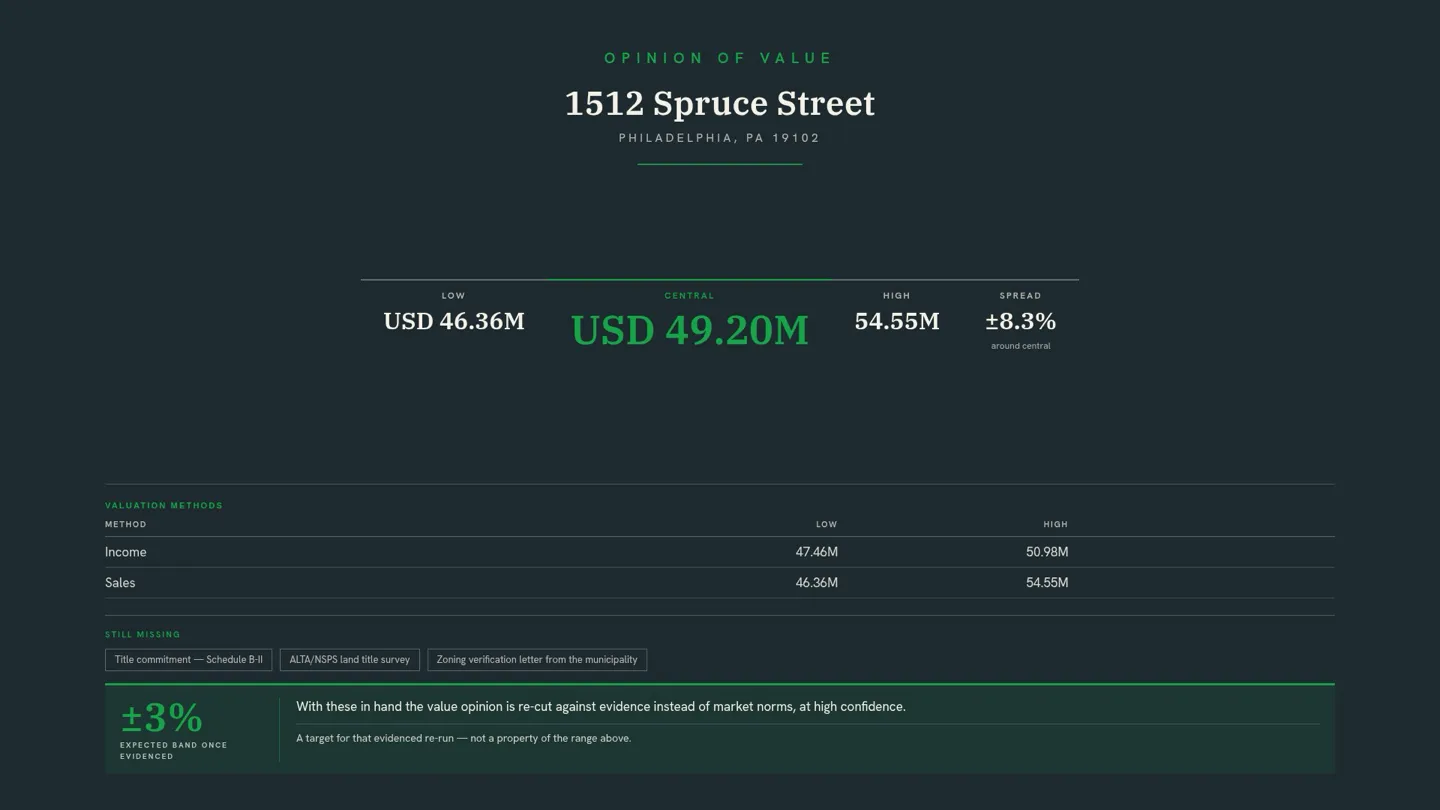
The Drake
1512 Spruce Street, Philadelphia
$49.2M opinion of value for 286 apartments and the theatre unit, range $47.5M to $51.0M
- apartments
- 286
- per apartment
- $172,028
- implied cap rate
- 6.30%
Sample package · 12 files
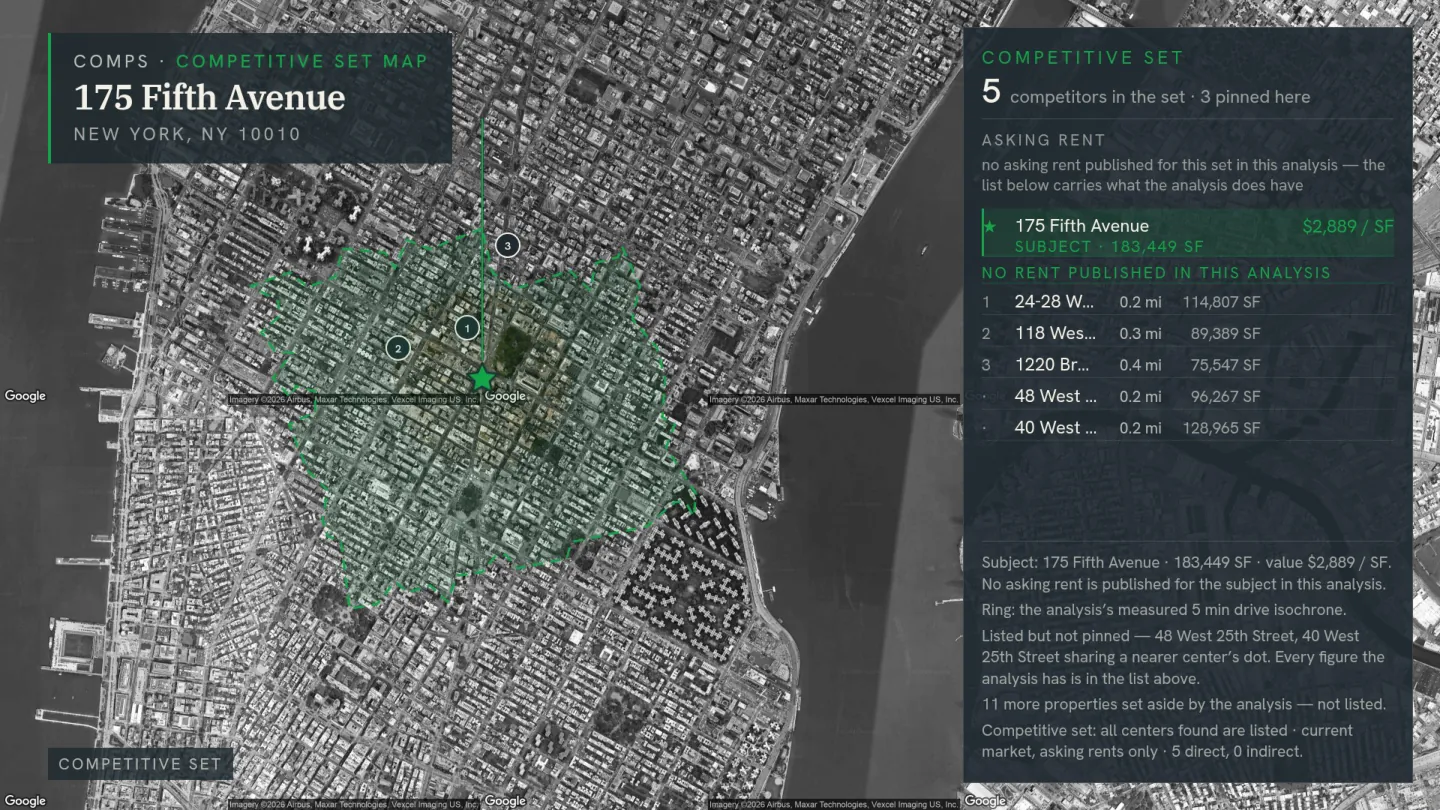
The Flatiron Building
175 Fifth Avenue, New York
$530M concluded value, range $450M to $580M
- NOI
- $7.32M
- building area
- 183,449 SF
- comparables
- 22
Sample package · 6 files
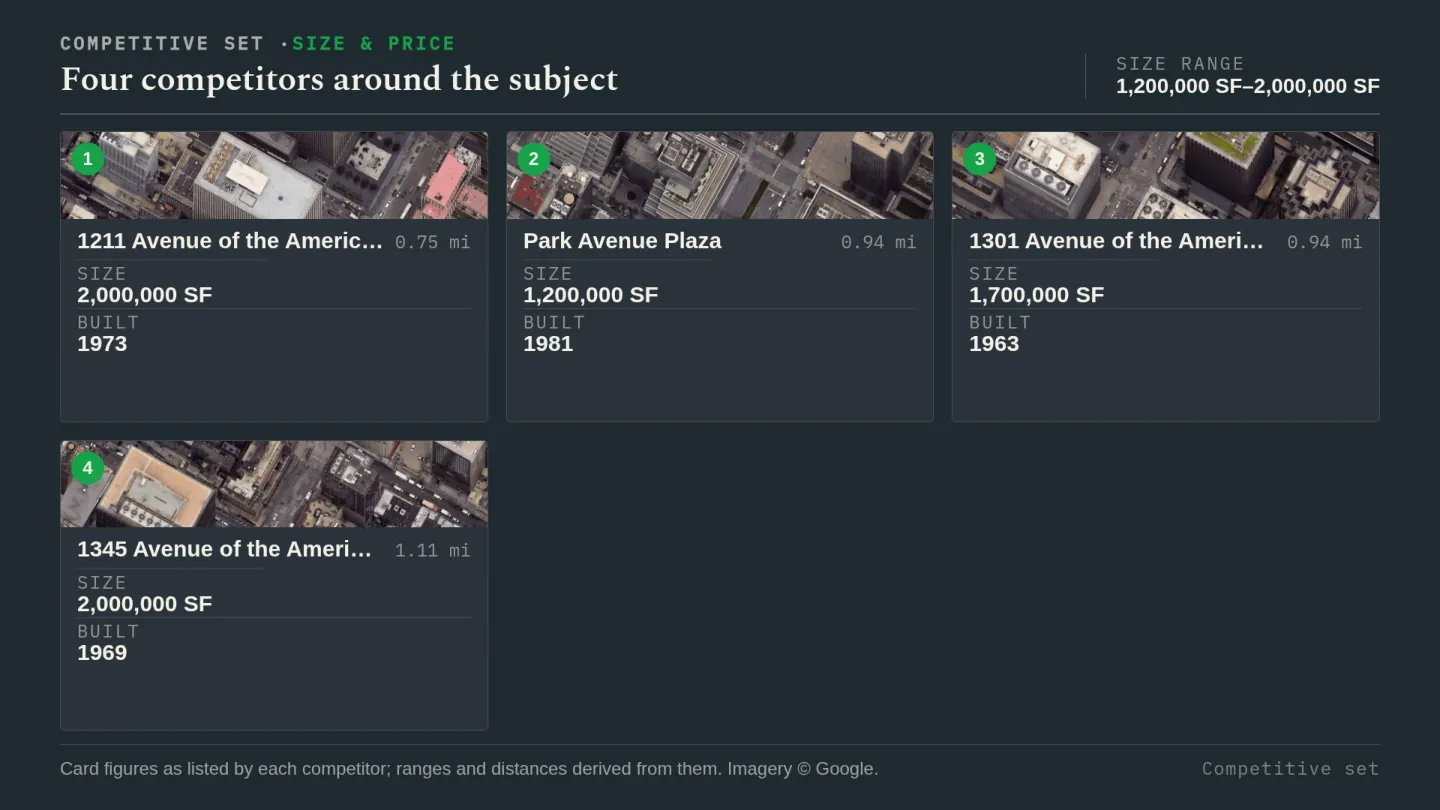
The Empire State Building
350 Fifth Avenue, New York
$2.53B concluded value, range $2.34B to $2.71B
- NOI
- $108.1M
- building area
- 2.81M SF
- occupancy
- 88.7%
Sample package · 10 files
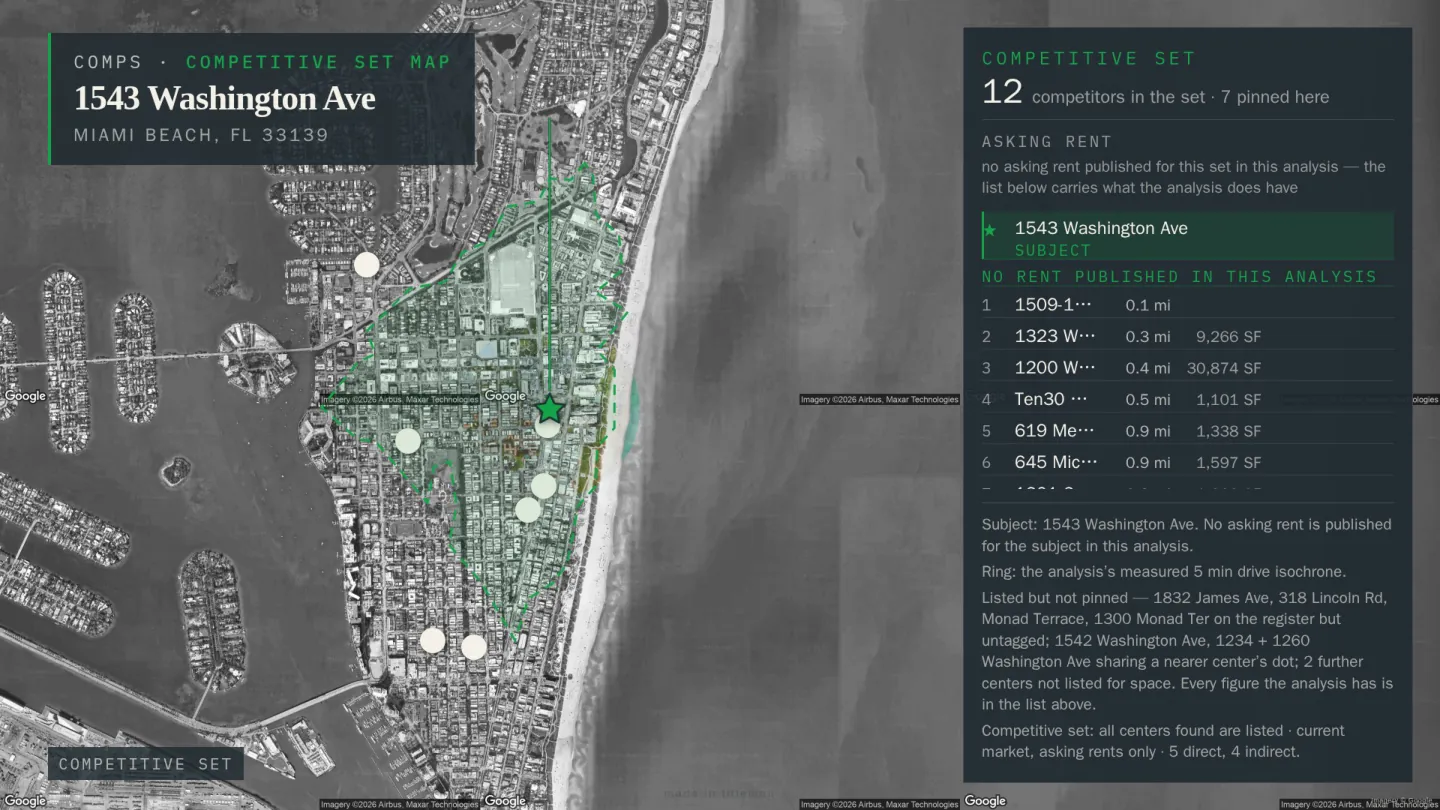
1543 Washington Avenue
Miami Beach, Florida
Build 21 condominium units over ground-floor retail, by right
- floor area allowed
- 26,250 SF
- height, from the code
- 55 ft
- FAR
- 1.5
Signals
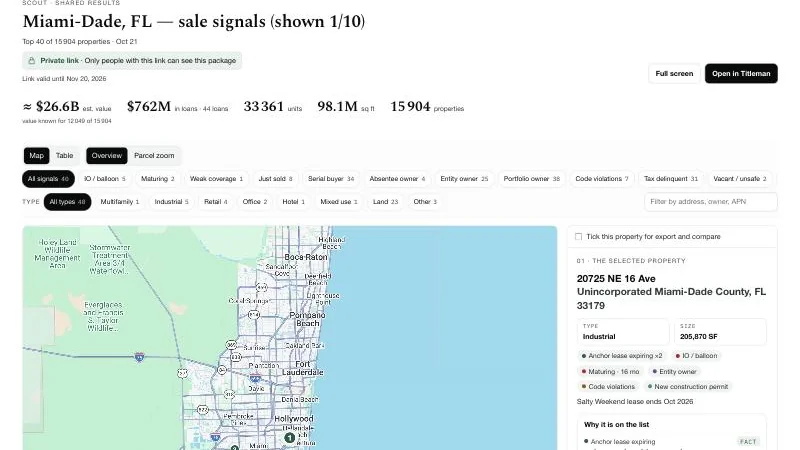
Miami-Dade County: sale signals
Miami-Dade County, Florida
15,904 properties read, the 40 strongest shown (1/10 of the list)
- estimated value
- $26.6B
- in loans
- $762M
- units
- 33,361
Drafts for a licensed professional to review and sign; not appraisals.
Your stack, any stack. Our engine in the middle. Answers land where you work.
Everything you have now stays yours. It runs through the Titleman engine for real estate, gets enriched with our sources, and the conclusions come back to wherever you read them. Set up once, it runs on its own: no moving files by hand, no clicking around.
What you already have
- Your inbox
- Your data rooms
- Your CRM
- Your Excel models
- The territory you set
The Titleman engine for real estate
- Reads it
- Enriches it with 2,100+ connected sources, 1,912 already returning data
- Draws the conclusions
Lands where you like
- Telegram
- Your CRM or model
Your workflows, on our engine
Each one starts where your work already starts and ends where you read it. Two run for every team: the inbox and the radar. The others are yours.
A loan request lands in your inbox
Back in the same thread after our team checks it: the borrower package spread on your template, the credit memo draft and the flags with their pages. The loan amount stays with your committee.
The radar on your footprint
A weekly digest by e-mail, Telegram or WhatsApp: the borrowers who will need a lender.
More accurate, faster, lower cost per deal
More accurate
The package checked against itself and against what is on record; a gap is named with its amount and page, never filled in.
- Every input shows its source and date; every result shows its formula.
- What we could not find is named as missing, never filled in.
- The same Underwriting request on the same files returns the same figures.
Faster
A property underwriting from the loan request package in about an hour, plus a due-diligence checklist where every item points to its document and page.
| Property passport | about 4 minutes |
|---|---|
| Underwriting with its live Excel model | about 1 hour |
Lower cost per deal
- One request returns the finished package: the memo, the live Excel, and the deck on request.
- An underwriting carries about 1,000 data points, each marked as found with its source, computed by formula, or missing.
- Your analysts check and decide instead of collecting.
Questions teams ask first
- How do lenders screen commercial real estate loans for default risk faster?
- They read the borrower’s package against itself before the credit team starts: the rent roll against the T‑12, both against the offering memo’s NOI, then debt coverage and debt yield at two rates. Titleman runs that tie-out as one run and returns each difference with the page and cell behind it; on one 50-unit loan package it showed the memo’s in-place NOI 32% above the T‑12, while the rent roll and the T‑12 agreed with each other. It screens the file and does not score default or make the credit call.
- Do we have to change how we work?
- No. Your stack stays yours. What arrives in your inbox, your data rooms and the territory you set runs through our engine, and the answers land where you work: e-mail, WhatsApp, Telegram or your CRM, as Excel, PowerPoint, PDF and Word. Nothing new to log into.
- What do you bring, and what do we keep?
- 2,100+ connected sources (parcels and owners of record, recorded sales and loans, permits, zoning and rents) and a property base of about 6 million properties. Your files serve your work, are never shown to another client and are not used to train models. An NDA comes before any access.
- Does Titleman make the credit decision?
- No. Titleman gives no credit opinion and no appraisal of its own, and the memo states no loan amount. The coverage and debt yield math sits in the workbook; the decision to lend stays with your committee.
- How long until it runs on our own work?
- 72 hours from access, after the NDA. Day 1 we map the process with you, day 2 we build it into your setup and run one live case, day 3 your team runs it and we measure it together.
- Can we try it first?
- Yes: up to 2 weeks of work by email on your own deals, no login. Access for your team opens with a pilot, from one page of terms agreed before anything opens: the processes it covers, the numbers that count as success, the people on both sides, 14 days at most and the date you decide. How you start with Titleman