AI and reports are full of holes.We check every number in your deal documents against the market before you sign.
| Cell | Line | Value | Check |
|---|---|---|---|
| B4 | Lot area, SF | 17,500 | Verified |
| B90 | Lot area, other entry | 175,000 | Red flag |
| B19 | FAR | 1.5 | Verified |
| B14 | Last sale, 1993 | 950,000 | Review |
| B22 | Max density, u/ac | 100 | Red flag |
| F30 | Formula, recomputed | 27,219,221 | Verified |
Density is 74 u/ac in the PDF memo and 100 u/ac here. At most one is right, and every figure built on the other moves with it.
Watch the 70-second demo
Your own files, marked where each figure sits
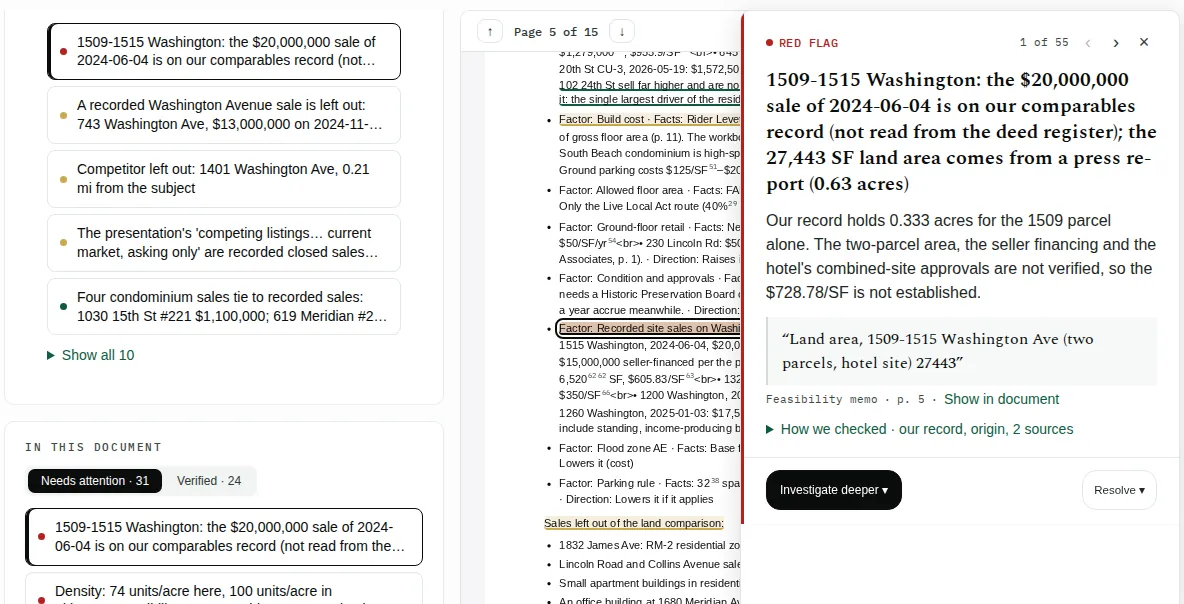
Every figure marked on a copy of your files
Each figure in the rent roll, T‑12 and model is marked verified, to review or red flag on a marked copy of the workbook. Findings in the OM point to their page. Your originals stay as they were.
A cited report, by category
Property facts, comps and value, rents, title and legal, assumptions, model math, risks: every finding with its source and date, and a page of what could not be checked.
The conclusion, then the next question
The main points in chat, each with the findings it rests on, and one click to run follow-up research on any finding.
What was checked, in numbers
Every review opens with the count: how many files, how many items, how many were checked and how many were not. A findings register comes with it.
Questions teams ask first
- What can I send?
- The deal’s documents as they are: the OM or deck, the underwriting model, the rent roll and T‑12, memos, leases, legal, zoning and title files, and scanned pages. PDF, Excel and Word.
- Do you change my files?
- No. The marks go on a copy of each workbook, with a note on each marked cell and a new Underwriting sheet. Findings in a PDF or a memo point to their page and paragraph. Your originals stay as they were.
- What is it checked against?
- Each kind of claim against its own kind of proof: market figures against recorded sales, leases and listings; assumptions against forecasts and research; facts against the record they came from; the math against its own inputs, recomputed by code. 2,100+ sources stand behind the checks, and every finding shows its source and date.
- How long does it take?
- Our six-file test package took about 78 minutes end to end. A larger package takes longer, and the review says how many items it checked.
- Who sees my documents?
- We sign an NDA first. Your files stay yours and are never shown to another client.
- Does it tell me whether to do the deal?
- No. It tells you which numbers hold, which do not, and why, with the source for each. The decision stays with you and your committee.
Put Underwriting on every package you receive
Leave your work email and tell us where deal packages reach your team: the inbox, the data room, the broker portal. We reply by email, show you a finished review and map how every package that arrives gets checked before your committee reads it.
Underwriting reads only the files you send. It says how many items it checked and how many it did not.
Titleman is not a broker, appraiser or law firm. Underwriting is a check of documents for your team to review; the decision stays with your committee.