AI and reports are full of holes.We check every number in your deal documents against the market before you sign.
| Cell | Line | Value | Check |
|---|---|---|---|
| B4 | Lot area, SF | 17,500 | Verified |
| B90 | Lot area, other entry | 175,000 | Red flag |
| B19 | FAR | 1.5 | Verified |
| B14 | Last sale, 1993 | 950,000 | Review |
| B22 | Max density, u/ac | 100 | Red flag |
| F30 | Formula, recomputed | 27,219,221 | Verified |
Density is 74 u/ac in the PDF memo and 100 u/ac here. At most one is right, and every figure built on the other moves with it.
One deal package, one review
- 1,788figures, formulas and statements checked
- 876formulas recomputed by code
- 6red flags that can change the decision
A sample review run by our team on a six-file deal package, October 2026. Nothing was left unchecked. 46 more items are marked to review.
The problem
Everyone writes deals with AI now. Fewer people check what it wrote.
Draft
The AI cites a comp at $728/SF
Model
It sets the land value
Memo
“Supported by recent sales”
Committee
A price set on a sale nobody traced
Deal Review stops it at the first step: is the sale on record, at that price, for that land, and who said it first?
What one miss costs on a $50M deal
$2.4MAn exit cap 25 bp too low on $2.5M of NOI: about 14% of the equity at 65% leverage.
Illustrative figures
How it works
From your files to marked files, with every check cited
1 · Your files
- Offering memo or deck
- Underwriting model
- Rent roll, T‑12
- Investment memo
- Legal, zoning, title
- Scans
2 · Every item found
- Every figure, with its page or cell
- Every formula, with its inputs
- Every statement: fact, assumption, conclusion
3 · Checked
- Formulas recomputedBy code, from their own inputs, and the same figure compared across files.
- Against the marketRents, sales, cap rates and competitors against our records and the market range.
- Against forecastsGrowth, exit cap, vacancy and costs against forecasts and research.
- Traced to the originWhere each fact was first stated, by whom and when.
4 · Back to you
- Your files, marked
- A cited PDF report
- The conclusion in chat
- A findings register
Checked by the Titleman engine for real estate, against 2,100+ sources.
The rule
Every line gets a color, and the color has a rule
- Verified
Within 3% of an independent figure, with a cited source, or the file’s own math ties out.
- Review
3% to 10% off, or the support is missing.
- Red flag
More than 10% off, with a cited source. It can change the decision.
A finding is green or red only with a cited source. Without one, it stays yellow. A conclusion is green only if everything it rests on is green.
What comes back
Your own files, marked where each figure sits
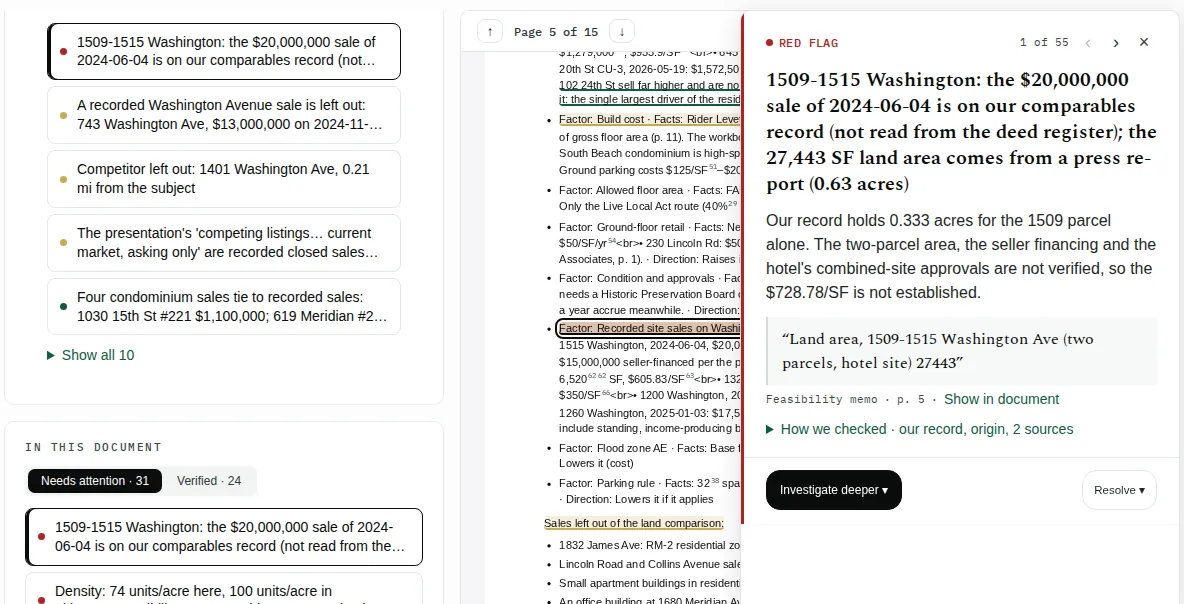
- 01
Every figure marked on a copy of your files
Each figure in the rent roll, T‑12 and model is marked verified, to review or red flag on a marked copy of the workbook. Findings in the OM point to their page. Your originals stay as they were.
- 02
A cited report, by category
Property facts, comps and value, rents, title and legal, assumptions, model math, risks: every finding with its source and date, and a page of what could not be checked.
- 03
The conclusion, then the next question
The main points in chat, each with the findings it rests on, and one click to run follow-up research on any finding: comps, market rent, competitors, underwriting from scratch.
- 04
What was checked, in numbers
Every review opens with the count: how many files, how many items, how many were checked and how many were not. A findings register comes with it.
Proof · our test case
One development package, six files. Every item checked.
Land and redevelopment underwriting, reviewed October 2026
- 1,788
figures, formulas and statements found in 6 files, 1,788 checked
- 876
formulas recomputed by code from their own inputs
- 14
cross-file checks: the same figure compared between files
- 965
findings, every one located in its original file
- Feasibility workbook, 8 sheets
- Sensitivity workbook
- Investment memo, 15 pages
- Word memo and DD checklist
- Presentation, 13 image-only slides
- Zoning report, 3 pages
What it found
Findings from the test case, each pinned to its place
- Sales compsRed flag
A $20,000,000 comp that is not on the deed register
The neighboring sale sits only in a comps record, and its 27,443 SF of land comes from a press story. Our records hold 0.33 acres for one of its two parcels. The $728.78/SF is not established.
Feasibility workbook · comparables
- RisksRed flag
“By right, no hearing” against a required certificate
The Word memo calls the scheme by right. The PDF memo says demolition needs a historic-board certificate. The approval path is stated both ways.
Word memo ¶11 · PDF memo
- Sales compsReview
“Land sales” that were income buildings
The sales used as land comps are improved, income-producing buildings divided by land area. The per-land-SF median overstates bare land by the value of the buildings.
Feasibility workbook · investment memo
- CompetitorsReview
“Competing listings” that were not competitors
The deck’s map of the current market shows recorded closed sales and condo unit sales: comparables, not properties competing for tenants or buyers.
Presentation · map slide
- Market rentsVerified
$84.96/SF ties to the record, but the link points elsewhere
The rent ties to our recorded leases for its address. The link the files cite is a listing at another building, so the evidence in the file does not show what it claims.
Sensitivity workbook · rent comparables
- Market rentsReview
A 2012 rent of $31/SF in a 2026 file
An asking rent from a 2012 scan, from before the fire. It says nothing about today’s market, and it is marked so nobody carries it forward.
Investment memo · rent evidence
Competitors
Only true competitors stay. The rest are named, with the reason.
Change the competitor set and the rent, the occupancy and the value move with it. So the set itself is checked: real buildings of the same kind and a comparable size, nearest first, each on the map with the subject.
Direct competitors, kept
- 1In your files, confirmed1.3 mi
- 2In your files, confirmed1.3 mi
- 3In your files, confirmed1.9 mi
- 4Found by us, a direct competitor2.1 mi
Found by us, left out of the files
- 5Left out of your files, closer than any you name0.7 mi · red flag
Set aside, with the reason
- AA condo unit sale, not a competing property1.9 mi
- BA closed sale shown as a “competing listing”2.7 mi
- CBeyond the competitor radius4.9 mi
Illustrative map, synthetic points. Distance is measured from the subject in a straight line, so a highway or water between them stays visible to your analyst.
Two depths
Every review says what it checked, and what it did not
Every review
The material items first
- Code checks every formula and the consistency between files.
- The engine checks first what moves the decision: price, NOI, rents, cap rates, areas, debt terms, assumptions, conclusions.
- Anything left unchecked is counted and listed, never hidden.
Full verification
Every figure, formula and statement
- Every item of the package gets a status; the review closes at full coverage.
- Built for data rooms and packages with thousands of lines.
- Our team turns it on for your deal; ask on your first one.
“In 6 files we found 1,788 figures, formulas and statements. Code checked all 876 formulas and the cross-file consistency. Of the rest, the model checked the 898 most material. No item was left unchecked.”
On the cover of the test case’s report
Who it is for
For the person who signs
The IC memo, the loan approval, the purchase agreement. Before your name goes on it, know which numbers hold and which do not.
Investors
The OM and the model checked before you bid or take the deal to IC.
Titleman for investors →Lenders
The numbers in the borrower’s package checked against each other and the market before credit committee.
Titleman for lenders →Brokers
Your own OM and BOV checked before they go out under your name.
Titleman for brokers →Developers
The feasibility model and the land comps checked before you close on the site.
Titleman for developers →Owners and asset managers
The budget and the business plan checked against your leases and the market.
Titleman for owners and asset managers →
Deal Review on two pages
For your team: Deal Review for your role, on two pages. A direct download, no form.
Questions teams ask first
- What can I send?
- The deal’s documents as they are: the OM or deck, the underwriting model, the rent roll and T‑12, memos, leases, legal, zoning and title files, and scanned pages. PDF, Excel and Word.
- Do you change my files?
- No. The marks go on a copy of each workbook, with a note on each marked cell and a new Deal Review sheet. Findings in a PDF or a memo point to their page and paragraph. Your originals stay as they were.
- What is it checked against?
- Each kind of claim against its own kind of proof: market figures against recorded sales, leases and listings; assumptions against forecasts and research; facts against the record they came from; the math against its own inputs, recomputed by code. 2,100+ sources stand behind the checks, and every finding shows its source and date.
- How long does it take?
- Our six-file test package took about 78 minutes end to end. A larger package takes longer, and the review says how many items it checked.
- Who sees my documents?
- We sign an NDA first. Your files stay yours and are never shown to another client.
- Does it tell me whether to do the deal?
- No. It tells you which numbers hold, which do not, and why, with the source for each. The decision stays with you and your committee.
Deal Review
Send one deal’s documents
Leave your work email and name the deal in the message box. We reply by email. You send the files: OM, rent roll, T‑12, model, leases. We return the review on that one deal and walk your team through it in an hour.
Deal Review reads only the files you send. It says how many items it checked and how many it did not.
Titleman is not a broker, appraiser or law firm. Deal Review is a check of documents for your team to review; the decision stays with your committee.