The report is the deliverable, not a summary of one. It lands in the room the job was stated in, and it is built so that somebody who was not in the conversation can check it.
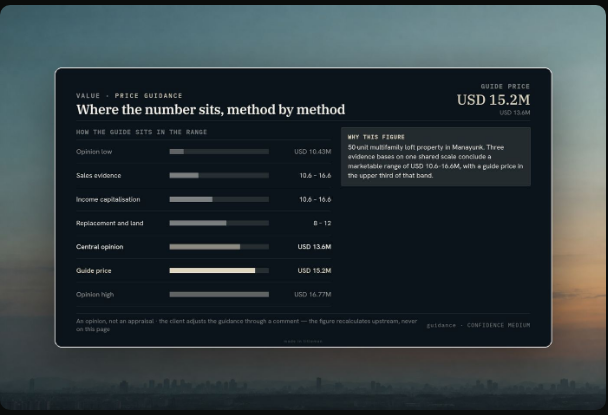
Every figure names its source
This is the rule the whole system is built around: a number arrives with the thing that produced it — a county record, a transaction, a document you sent, a calculation whose inputs are on the page.
So the useful way to read a report is not top to bottom. It is:
- Find the number the decision turns on.
- Follow it to its source.
- Decide whether that source is good enough for your committee.
A number you cannot trace that way is one you should ask about, and asking is the right move rather than a nuisance.
An omission is not a zero
When a value was not available, you should see it missing or stated as unknown — not filled with a typical figure. A default silently substituted for a measurement is the failure mode we work hardest against, because it looks exactly like an answer.
If you see a suspiciously round number with no source behind it, treat it as unverified and say so. Roundness is usually the trace of something recalled rather than measured.
"No data" means the register, not the market
If a section comes back thin, the first question is whether we have coverage where your property is — not whether the market is empty. Those look identical in a report and they are completely different facts.
Coverage is uneven and public: Coverage and data lists it by country and by US state. Check it before reading a thin answer as a finding.
What the report is not
It is not an appraisal, and it is not legal or tax advice. It is an opinion of value, an underwriting, a feasibility or a comparables board, with its working shown — made to be argued with rather than believed.