A small commercial real estate firm reviews more deals with the same team by putting a first reader on every deal before anyone spends an afternoon on it. With Titleman that reader is an AI analyst you hire the way you would hire a person: on probation first, then with more of the work as it earns it. This page is the path, stage by stage, and what decides each step.
The constraint is reading time, not judgment
A three-person acquisitions team does not lack judgment. It lacks the hours to open every offering memo that lands in the inbox, reconcile the rent roll with the T-12, and work out whether the asking price makes any sense before the call for offers. So the team reads the deals that look good from the email, and the rest go unread. How many days it takes to screen a CRE deal puts numbers on that gap.
An analyst that reads every deal first changes which deals get the team's time. It does not change who decides.
Stage 1: probation, seven days on your live deals
You do not set anything up. You forward deals by email, as they reached you, and the review comes back in the same thread. The week has a fixed shape:
- Day 1. You forward the first deals and name your red lines: what your firm never buys or lends on, and the numbers you will not go below.
- Days 2 to 5. The analyst reviews what you forward. You correct it by reply: "next time…", "we never…", "our threshold is…". Each correction is written down as a rule for your firm, and the next review follows it.
- Day 6. A report: deals reviewed, how often the review matched your own analyst on the same deal, and corrections applied.
- Day 7. A call, and you decide.
If your investment committee cannot meet within a week, the probation can run up to 14 days. During probation the analyst only reads and reviews: it signs nothing, writes to no one outside your firm without your ok, and spends nothing.
What to expect from the first week
The scale is how often the review matches the decision and corrections of your own analyst on the same deal. The typical path:
- Week 1, about 7 out of 10. It knows the market, not yet you. Comps, rents, income and value hold up; your assumptions and thresholds are still being learned.
- Month 1, about 8.5. Your cap rate logic, your thresholds and your preferred brokers are rules now, applied on every deal.
- Month 2, about 9.5 to 10. Most reviews need no correction. The ones that do are new cases, and they become rules too.
That is a typical path, not yet a measured result across clients. Your own figure is the one in your weekly report, measured on your deals.
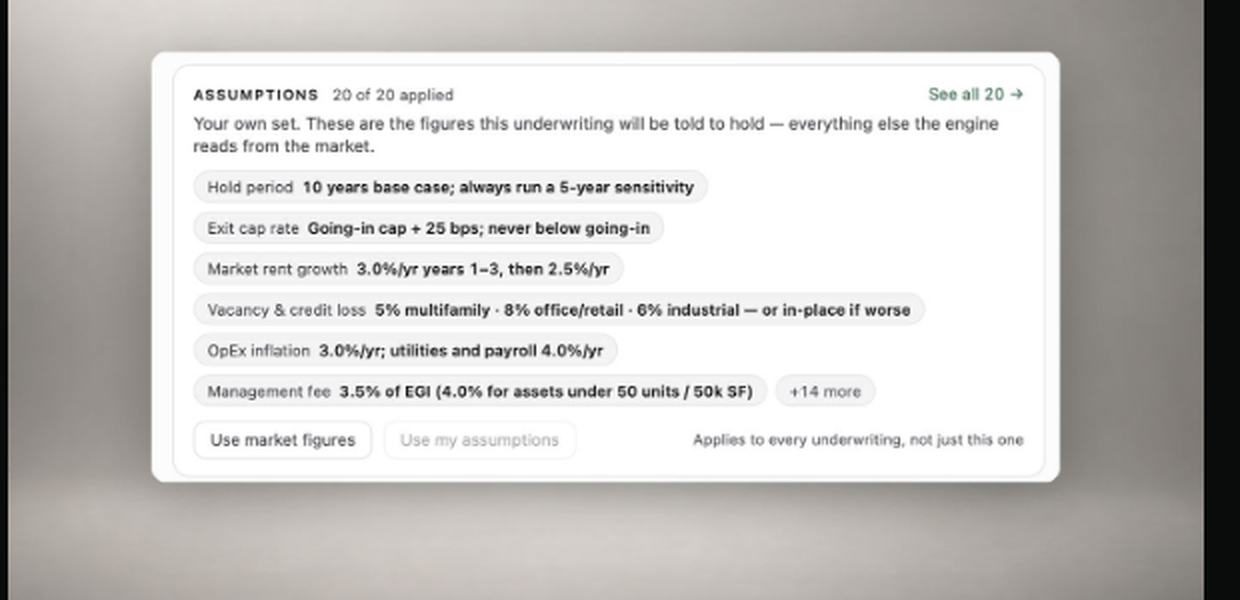
The rules live where you can see them. In an underwriting, your house standards sit next to the market figures, and the card says how many of them were applied.
Stage 2: part-time, the deals you choose
After probation, most firms start narrow: one desk, one deal type, or the deals someone wants a second read on before they spend time on them. The analyst still works by email and still reports to whoever forwards. This is where a firm finds out which deals it trusts the first read on.
Stage 3: full-time, every deal that reaches you
Every deal that reaches the firm is reviewed the way your team would review it, before your team spends time on it. The team stops triaging by email subject line. A deal that crosses one of your red lines says so; a deal that holds up arrives with the work already done.
Stage 4: senior, your right hand
A senior analyst watches your markets for you and prepares the deal for your investment committee: the memo, the model and the questions a committee member will ask. It is still not the one who signs. A professional on your side reviews and signs.
Stage 5: a team, one analyst per desk
Acquisitions, asset management and lending read deals differently. A team means one analyst per desk, each with the rules of its own desk: the acquisitions analyst's cap rate logic does not leak into the lending analyst's debt yield floor.
What decides each step
Two things, both yours. The match figure in your weekly report, which tells you how often the review agrees with your own analyst. And how much you want to extend: authority grows only as your trust does, and only when you say so, one written rule at a time. The role grows in responsibility; what the analyst may do alone stays where you set it.
How your analyst learns shows the correction loop in detail, and your data stays yours covers where the files and rules live. To start, see the 7-day probation.
If you would rather see the analyst on a deal of yours first, book a demo.
Updated 22 October 2026. Written by the Titleman team with AI assistance.
FAQ
How do small CRE investment firms analyze more deals with fewer analysts?
By putting a first reader on every deal, so the team spends its hours on the deals worth it. An AI analyst reads the offering memo, rent roll and T-12, checks the claims and sends back a review in the same email thread. Your analysts correct it by reply, and the corrections become rules for your firm.
What happens during the 7-day probation?
Day 1, you forward the first deals and name your red lines. Days 2 to 5, the analyst reviews what you forward and you correct it by reply. Day 6, you get a report: deals reviewed, how often the review matched your own analyst, and corrections applied. Day 7, a call, and you decide. If your committee cannot meet within a week, it can run up to 14 days.
How good is it in the first week?
Typically about 7 out of 10: it knows the market, not yet your firm. The typical path is about 8.5 after a month and 9.5 to 10 after two. That is a typical path, not a measured result; your own figure is the one in your weekly report.
Does it replace our analysts?
No. It reviews every deal the way your analyst would, so your analyst spends time on the deals worth it. It also keeps every rule your team has given it, so a correction made once is not lost when someone moves on.
What changes when the role grows?
What it reads and who it reports to, never what it may do alone. At every stage it signs nothing, writes outside your firm only with your ok, and spends nothing, unless you extend that in writing.