A broker's opinion of value across a list of addresses in one pass, returned as a table with the reasoning behind each line. It is what you use to price a batch — a portfolio, a farm area, a pitch list.
It is the most active product we have: 238 runs since January, 132 of them in the last thirty days.
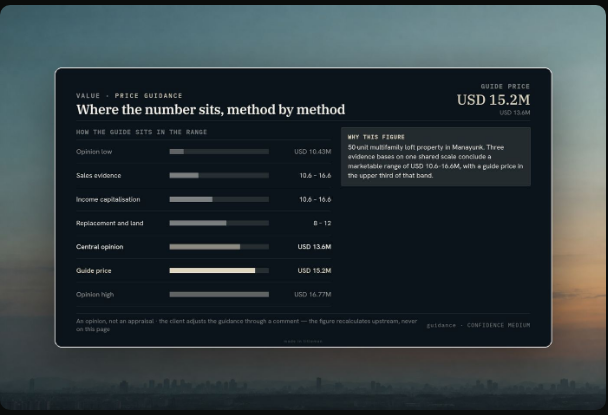
A worked example, in full: the brief, what came back, the comparable count and the time it took for 1543 Washington Ave, Miami Beach, is on Showcase — along with an OM on a client template and a listing pitch, each with its own brief. The cases show what the work produced; they are not a download.
How to run it
Paste between one and twenty addresses, one per line. Nothing else is required.
Everything else is optional and useful: the asset class if the use is unusual, the purpose of the exercise, any constraint that would change how you read the numbers.
What comes back
- A canvas report with the valuation table — 65% of runs in the last thirty days.
- A slide deck on about 19% of runs, roughly fifteen to twenty slides. This is the only product that produces one.
Median 20 minutes, 90th percentile 44. Median 3.2 credits — the cheapest substantial product we have.
Do
- Batch aggressively. The per-run cost barely moves between one address and twenty, so a pitch list is far cheaper here than twenty separate jobs.
- Say what the batch is for. Pricing a portfolio and building a farm-area pitch want different emphasis in the same table.
- Read the range as information. A point value needs at least three comparable sales behind it. Below that the answer deliberately becomes a range — that is the product telling you the evidence is thin, not hedging.
Do not
- Do not plan a client meeting around the deck. It arrives on about one run in five. Ask for it and we will produce it if the data supports it, but do not put it in a calendar invite before it exists.
- Do not paste more than twenty addresses. Split the list instead.
- Do not assume the comparables are strong. Comparable quality is the weak spot across this product: the sets fail our own quality check more often than they pass it. Open the comps behind any line the decision turns on.
- Do not run it outside the United States expecting register-backed comparables. See Coverage and data.