The first week of an AI analyst at a real estate firm is a probation on your own deals, not a demo. Day 1: you send live deals and name your red lines. Days 2 to 5: it reviews deals and you correct it by reply. Day 6: it reports how often it matched your team. Day 7: you decide.
Updated 22 October 2026. Published by Titleman.
Why seven days
A demo shows what a tool can do on a deal someone else picked. A probation shows what the analyst does on your deals, with your thresholds, in front of the people who will rely on it. A week of live deals is enough to see two things: whether it reads a deal the way your team does, and whether a correction you send on Tuesday shows up in Thursday's memo.
Seven days is the default. It runs up to 14 days only when your investment committee or your deal cycle cannot fit in a week, and then the reason is written down in one line on day 1. The offer itself is on Hire Titleman on a 7-day probationary period.
The week, day by day
| Day | What you do | What the analyst does | What you have at the end of the day |
|---|---|---|---|
| 1 | Forward two or three live deals with everything on them; name your red lines | Reads every file, asks before it guesses, starts the first reviews | Your red lines written as rules for your firm |
| 2 to 5 | Read each memo and correct it by reply | Reviews new deals; applies each correction to the next memo and says so | A memo per deal and a growing list of your rules |
| 6 | Nothing | Writes the report: deals reviewed, match with your team, corrections applied | One page with the counts from your own week |
| 7 | A call with the person who signs | Answers questions on any memo from the week | A decision |
Day 1: your deals and your red lines
Send what you would give a new hire: the offering memorandum, the rent roll, the T-12, the broker's emails, your own notes. The more of the file it has, the less it has to ask.
Then say your red lines in plain words. For example: "we never buy below a 1.25x DSCR", "no ground leases", "we underwrite vacancy at our own number, not the broker's". Each one is recorded as a rule under your firm and checked on every deal that follows. These are examples of what a client might say, not recommendations. Your list will be different.
Where something is unclear, it asks instead of guessing. On a valuation request from our own test account in October 2026 the first reply was: "Before I start the analysis I need to be sure what this property is… What I could not establish, and would rather ask than guess: which parcel exactly." A wrong parcel would have made every figure after it wrong, so the question came first.
Days 2 to 5: reviews and corrections
Each review comes back as a memo with findings you can open one by one: what was found, where in the document, how it was checked, and a button to resolve it.
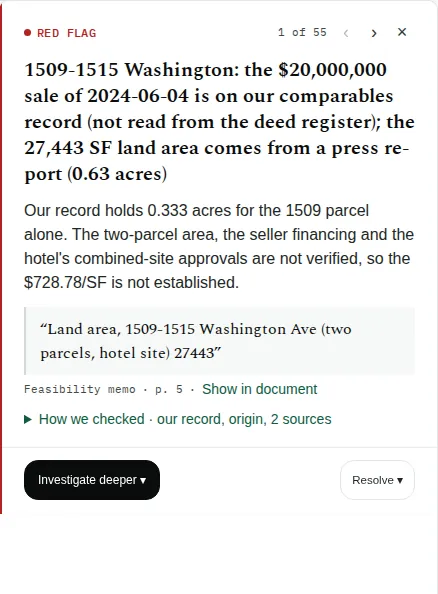
You correct it the way you would correct a junior analyst: reply to the memo. "Next time, use our vacancy, not the broker's." "We never count parking income on this asset type." "Our threshold is 6.5% going-in." On our test account in October 2026, a user answered the analyst's question with "The building is 136,783 square feet in total (… not 1.37 million)", and the valuation ran on the corrected area.
What matters in these four days is not whether the first memo is perfect. It is whether the third memo already carries the rules from the first two. Each memo that applies a correction says so: "as you asked, vacancy is at your figure". A correction that does not show up next time is treated as an error on our side, not as a learning curve. How the loop works in detail: how your analyst learns.
If a run includes full underwriting, it takes about 58 minutes at the median on production runs in the 30 days to 18 October 2026. A median, not a promise.
Day 6: the report
The report is one page, written from your week only:
- Reviewed: the number of deals and memos.
- Match: on how many of the calls in those memos your team agreed, and where it did not.
- Corrections applied: how many of your corrections were applied in a later memo, out of how many you sent.
There is no score from someone else's deals in it. How we count the match is set out in measuring an AI analyst week by week.
Day 7: the decision
A call with the person who signs. You have the memos, the rules list and the report. The choices are plain: hire the analyst for a larger role, extend to 14 days if a committee date fell outside the week, or stop. Nothing renews by itself.
What it does not do during the week
- It signs nothing. A named person on your team reviews every memo before it is used.
- It writes to nobody outside your firm without your "ok".
- It spends nothing on your behalf.
These limits are its job description. Authority grows only as it earns trust, the same way it would for a person.
How to get the most out of the week
- Send real deals, including one your team already decided on, so you can compare.
- Correct by reply, in your own words, as soon as you read the memo.
- Name your red lines on day 1, not on day 5.
- Bring a second person from the team into the replies.
- Put the day-7 call in the signer's calendar on day 1.
FAQ
What happens in the first week after hiring an AI analyst for real estate?
Day 1 you send live deals and name your red lines. Days 2 to 5 the analyst reviews deals and you correct it by reply. Day 6 it reports how many deals it reviewed, how often it matched your team and which corrections it applied. Day 7 you and the person who signs decide.
Why is the probation seven days and not a month?
A week of live deals is enough to see whether the analyst reads them the way your team does and whether your corrections stick. It runs up to 14 days only when your investment committee cannot meet within a week.
What should we prepare before day 1?
Two or three live or recent deals with everything you have on them (offering memorandum, rent roll, T-12, broker emails), a short list of red lines, and the name of the person who will make the call on day 7.
Can the AI analyst sign, send or spend anything during probation?
No. It signs nothing, writes to nobody outside your firm without your ok, and spends nothing. A person on your team reviews every memo before it is used.
What happens after day 7?
You decide on the facts in the day-6 report: hire the analyst for a larger role, extend to 14 days if a committee date fell outside the week, or stop.
Read next: how your analyst learns, how an AI underwriting analyst learns your firm's style and AI agents vs software for CRE firms. The offer: hire Titleman on a 7-day probationary period. To start with a deal you know, request a demo.